Installing dual-screen hardware represents a significant capital expenditure for any organization. Miscalculating the orientation by even 15 degrees easily compromises screen visibility. You reduce precious dwell time and completely nullify the return on the second screen. Buyers often default to parallel or purely perpendicular street alignments. They do this without mapping actual traffic flow or user behaviors. They routinely ignore vehicle approach speeds and daily solar trajectories. This oversight causes poor readability and severely wasted screen potential. This comprehensive guide provides a reliable site-evaluation framework. It helps you determine exact orientation for maximum impact. You will learn to effectively balance bi-directional traffic capture against harsh environmental constraints. We also clearly cover important municipal compliance requirements. This ensures your outdoor displays achieve optimal, safe, and highly profitable placement. By treating screen placement as an exact science, you guarantee lasting engagement from every passing viewer.
Key Takeaways
- Speed Dictates Angle: Vehicular traffic requires strict perpendicular alignment for readability at speed, while pedestrian pathways benefit from angled orientations that align with natural walking trajectories.
- The "Legible" Angle: While manufacturers claim 178-degree visibility, the realistic legible pedestrian viewing angle falls within a 45-degree cone of vision.
- Sunlight Trumps Geometry: East/West facing screens face severe thermal and glare challenges during dawn and dusk; North/South orientations are structurally and visually optimal.
- Site-Specific Configuration: Shortlisting hardware requires matching the screen’s thermal management and brightness (nits) to the specific environmental reality of the chosen orientation.
The Business Case for Precise Two Sided Advertising Screen Placement
A double-sided unit costs roughly 40-60% more than a single-sided counterpart. Your placement must verifiably capture independent traffic streams on both sides. This ensures you justify the significant premium. Proper two sided advertising screen placement dictates the financial success of your project. If you fail to capture two distinct audiences, you essentially waste capital.
You must meet specific success criteria to maximize viewership:
- Approach Time: The orientation must allow for a minimum of 3 to 5 seconds of unobstructed reading time. You need this duration for the primary traffic flow. Readers need time to process digital content. They must perceive the message, read the text, and process the call to action.
- Bi-Directional Equity: Ensure neither screen faces a dead zone. Avoid pointing screens at blank brick walls or immediate dense foliage. Do not face an exit-only path where no approaching eyes exist. Each side must carry its own weight in viewership.
People incorrectly assume bidirectional road traffic automatically means equal screen value. You must actively avoid this common pitfall. If one side faces heavy morning stop-and-go traffic, it captures high dwell time. Commuters stuck in traffic read detailed messages. If the other faces high-speed evening traffic, engagement drops significantly. Fast-moving drivers only catch large visuals. You must adapt your content strategy and hardware selection accordingly. Your screen specs might need different brightness levels for each direction.
![Double Sided Outdoor Digital Signage Configuration]()
Analyzing Speed and Approach: Pedestrian vs. Vehicular Traffic
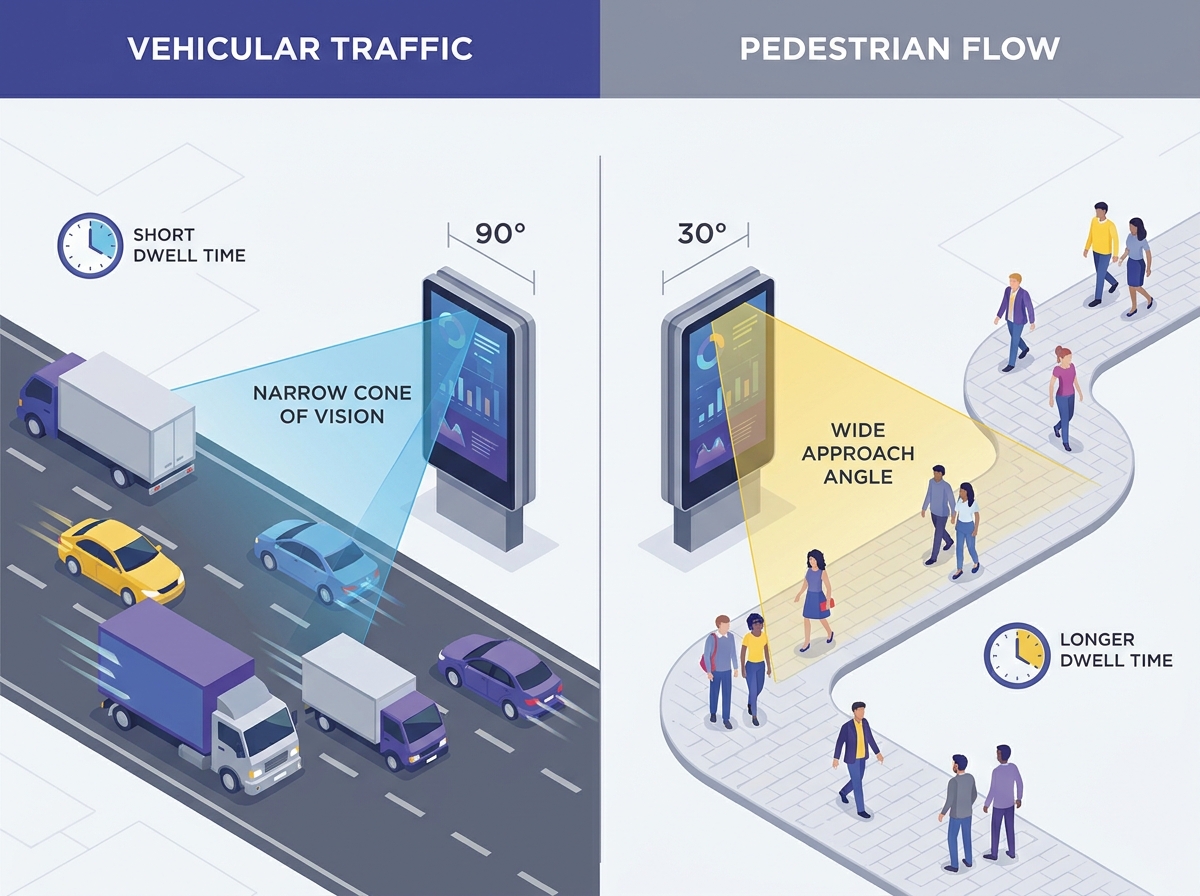
High-speed vehicular pathways require highly specific deployment strategies. They demand a 90-degree perpendicular street display orientation relative to the roadway. Setbacks must thoroughly account for peripheral vision limitations. Drivers moving over 35 mph possess narrow focal ranges. Their peripheral vision blurs naturally at higher speeds. You need strict, physical obstruction audits. Always factor in seasonal tree canopies that bloom in spring. Parked utility vehicles or delivery trucks can also block crucial sightlines. Place your screens where these temporary obstacles cannot reach.
Pedestrian walkways and plazas follow entirely different spatial rules. Walking speed averages merely about 3 mph. This much slower pace allows for dramatically longer dwell times. It also creates much wider natural approach angles. Avoid placing screens perfectly parallel to the walking path. Pedestrians rarely turn their heads 90 degrees while walking forward. Instead, angle the display 15–30 degrees into the primary flow of foot traffic. This naturally intercepts their forward line of sight.
Mixed-use environments present unique and complex spatial challenges. You often deal with cars, cyclists, and pedestrians simultaneously. If you target multiple groups, prioritize your highest-value audience first. Alternatively, prioritize the fastest-moving audience. High-speed viewers possess the absolute narrowest window for engagement.
Follow these targeted steps for mixed-use orientation:
- Identify the primary traffic artery near your installation site.
- Measure average speeds for both cars and foot traffic separately.
- Determine which specific audience generates the most valuable conversions.
- Angle the primary screen directly toward that specific group.
Calculating Outdoor Totem Sightlines and Pedestrian Viewing Angle
The spatial realities of the human cone of vision remain strict. Primary vision exclusively operates within a tight 10-degree cone. This narrow window represents where active, detailed reading occurs. Secondary vision extends outward to about 30 degrees. People notice motion, contrasting colors, and large text here. You must design the physical orientation carefully around these biological limits. Approaching viewers should naturally enter the 10-degree cone seamlessly. They should hit this optimal zone at the maximum legible distance. You calculate this exact distance using screen size and pixel pitch. Optimal outdoor totem sightlines depend entirely on these precise environmental metrics.
Discount ambitious manufacturer claims of 178-degree viewing angles immediately. Technically, you can see the illuminated screen from that extreme angle. However, text readability and critical call-to-actions suffer immensely. They experience severe color shift and intense foreshortening past 60 degrees. Realistic pedestrian viewing angle planning keeps viewers well inside the legible 45-degree cone. Anything outside this zone becomes unreadable visual noise.
Elevation and physical pitch also matter tremendously. Orientation is not merely a left and right decision. It heavily includes vertical tilt and structural mounting height. For standard totem installations, align the screen center properly. It should hit average human eye level for passing pedestrians. This is roughly 5'4" to 5'8" from the ground surface. Vehicular line-of-sight requires a slightly elevated position instead. The content must clear parked cars and street furniture easily. Angle elevated screens slightly downward to meet the approaching driver's gaze.
Environmental Factors: Sunlight, Glare, and Street Display Orientation
The daily solar path creates significant operational challenges outdoors. An East/West orientation presents very high thermal risks. One screen will take direct solar load in the morning hours. The opposite screen faces severe afternoon sun later. This demanding setup requires maximum brightness capabilities of 3500+ nits. It also necessitates aggressive HVAC systems or active fan cooling. Without adequate cooling, you risk sudden isotropic blackout. The screen physically goes black from intense internal heat buildup.
A North/South orientation carries much lower thermal risk overall. It provides highly consistent ambient lighting throughout the day. This optimal setup significantly reduces direct solar radiation exposure. You lower the operational strain on sensitive internal cooling components.
Environmental Impact by Display Orientation
| Orientation Type | Solar Load Risk | Cooling Requirement | Glare Potential |
| East / West | High (Direct Sun) | Aggressive (HVAC/Active) | Severe during dawn and dusk |
| North / South | Low (Indirect Light) | Moderate (Standard Fans) | Minimal throughout the day |
You must actively mitigate environmental glare everywhere. Evaluate surrounding reflective surfaces carefully during your site visit. Check for large glass buildings, polished metal, or standing water. A screen specifically oriented to avoid the direct sun might still fail. It could catch blinding light reflections from an adjacent skyscraper.
Wind load heavily dictates your structural engineering needs. Double-sided displays present a very large solid surface area. Orienting them completely perpendicular to prevailing high winds is risky. This physical placement increases structural stress on the mounting hardware significantly. Ensure your footings and mounts are heavily engineered. They must handle the specific wind-load realities of your chosen angle.
Shortlisting Your Double Sided Outdoor Digital Signage Configuration
Matching hardware specifications to your physical orientation is absolutely crucial. If strictly constrained to an East/West facing, you must mandate advanced hardware. Look exclusively for units offering advanced thermal management features. Liquid cooling systems or high-CFM active fans are essential here. You also strongly need bonded glass components. Bonded glass significantly reduces internal reflections and improves visual contrast.
If your physical orientation forces a wide approach angle, pivot your strategy. Prioritize hardware featuring premium IPS panel modules. Specialized LED modules also work exceptionally well in these scenarios. They heavily minimize color degradation when viewed off-center. Choosing the right double sided outdoor digital signage means matching tech specs to physical reality. Do not buy hardware before knowing your exact viewing angles.
Run municipal compliance and local zoning reality checks early. Before finalizing your exact orientation, aggressively verify municipal codes. Cities strictly regulate screen brightness projecting directly into traffic. They want to prevent driver distraction at night. Check all physical setback requirements from the street curb as well.
Your next steps require comprehensive physical site evaluation. Conduct a detailed site walk using a life-size cardboard mockup. Augmented reality applications also verify digital sightlines effectively. Request a formal, documented site audit from your trusted integration partner. Do this long before committing to an expensive footing pour. Do not dig electrical trenching without finalized orientation data.
Conclusion
Proper orientation requires comprehensive, data-driven planning. Moving beyond simple road alignment is vital for long-term operational success. You must calculate vehicle approach speeds, narrow viewing cones, and daily solar trajectories carefully. Treat display orientation as a strict, rigorous engineering decision. It is never just a subjective aesthetic choice. Base your final hardware placement on verifiable pedestrian and vehicular movement data. Ensure your precise hardware specifications match the harsh environmental reality of that exact angle. Engage a qualified digital signage integration specialist today. Conduct a formal sightline and environmental audit before making your final hardware purchase.
FAQ
Q: How far from the road should a double-sided outdoor display be placed?
A: Distance depends on local zoning setbacks, speed limits, and screen size. Generally, the faster the traffic, the further back the screen must be. A larger screen is necessary to allow safe viewing within the primary cone of vision without distracting drivers.
Q: Do both sides of a double-sided display need the same brightness?
A: Not necessarily. If one side faces direct morning sun and the other faces a shaded plaza, requirements differ. Ambient light sensors should independently control the nits for each screen. This optimizes visibility and conserves power efficiently.
Q: Can we adjust the angle of the display after installation?
A: Usually, no. Outdoor totems and large-format displays are typically bolted to poured concrete footings. The orientation must be perfectly planned. You must engineer the exact viewing angle prior to laying the concrete foundation.
Q: How does a screen's pixel pitch affect the ideal viewing distance?
A: A tighter pixel pitch allows for closer pedestrian viewing angles without image distortion. Pitches like 3mm or 4mm work great for sidewalks. Wider pitches, such as 10mm, require viewers to be further back. This heavily impacts how you orient the screen relative to walkways.