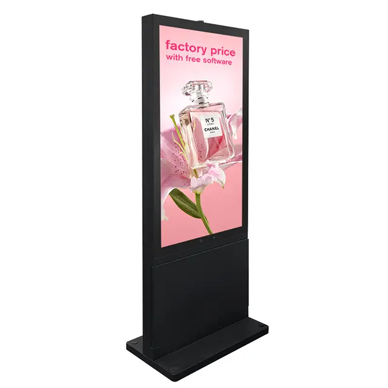
In today’s fast-paced world, visual communication is key to connecting brands with audiences. Whether at a shopping mall, airport terminal, or busy outdoor square, businesses rely on digital signage to deliver engaging content that captures attention instantly. However, outdoor advertising faces challenges such as strong sunlight, changing weather, and diverse viewing angles, which can affect message clarity.
Traditional digital displays often struggle under bright daylight. Sun glare can wash out images, and narrow viewing angles may limit how many people can see the content clearly, reducing campaign effectiveness and audience engagement.
This is where floor standing dual screen kiosks make a difference. Designed for outdoor and semi-outdoor environments, these advanced displays combine high-brightness screens with wide viewing angle technology, keeping content vivid, clear, and attention-grabbing even in harsh lighting conditions. Unlike conventional single-sided displays, dual screen kiosks present content on both sides, doubling exposure potential in high-traffic areas and maximizing audience reach.
For advertisers seeking strong visual impact outdoors, floor standing dual screen kiosks offer a reliable blend of performance, visibility, and engagement. In the following sections, we’ll explore how high-brightness technology and wide viewing angles make these kiosks ideal for modern digital signage.
High Brightness: Sunlight-Readable Technology for Outdoor Floor Standing Dual Screen Kiosks
Overcoming Visibility Challenges in Outdoor Environments
One of the most significant challenges for outdoor digital signage is maintaining clear visibility under direct sunlight. In bright daylight, ordinary displays can quickly appear dim, washed out, or even completely unreadable, which severely limits their effectiveness for advertising, public information, or interactive content. For businesses and organizations, this can mean lost opportunities for engagement and reduced impact of marketing campaigns.
This challenge is especially pronounced in high-traffic outdoor locations such as busy shopping streets, plazas, transportation hubs, airports, train stations, and other public areas where visual communication is essential. Here, viewers are often on the move, and messages must be legible from multiple distances and angles.
Floor standing dual screen kiosks are engineered specifically to overcome these visibility issues. Equipped with high-brightness display technology, including 2000-nit LCD panels, these kiosks ensure that content remains crisp, vivid, and fully readable, even under the harshest sunlight conditions. By maintaining consistent clarity, these digital kiosks allow businesses to effectively communicate promotions, brand messages, or public information at all times of day.
Understanding Nits and the Importance of Brightness Levels
A “nit” is the unit of measurement used to indicate screen brightness. While most standard indoor commercial displays operate in the range of 300 to 500 nits, outdoor-grade displays in floor standing dual screen kiosks achieve brightness levels of 2000 nits or more. This ultra-high brightness ensures that digital signage remains visible from long distances and in locations where ambient light might otherwise overpower standard screens.
High-brightness displays are typically enhanced with advanced LCD backlighting systems and optical bonding technology, which together minimize glare and reflection. This combination improves contrast, color accuracy, and overall readability, even in environments with intense direct sunlight or reflective surfaces, such as glass facades or polished sidewalks. For instance:
A kiosk installed on a sunny pedestrian street will still display clear promotional videos and interactive maps.
At a train station platform, schedules and advertisements remain legible even during peak daylight hours.
In public plazas or outdoor event spaces, visual content maintains its impact and attracts attention throughout the day.
By ensuring that content is always visible and high-quality, floor standing dual screen kiosks become a reliable and professional communication tool for outdoor advertising and public information.
Automatic Brightness Adjustment and Energy Efficiency
Modern sunlight-readable digital kiosks often include ambient light sensors that automatically adjust screen brightness according to the surrounding lighting conditions. During bright midday sun, the display increases brightness to ensure maximum readability. Conversely, in dimmer conditions, such as early morning, late evening, or cloudy days, the display reduces brightness to save energy and extend the lifespan of the panel.
This feature not only guarantees optimal visibility at all times but also enhances energy efficiency, which is particularly important for businesses managing multiple kiosks across different locations. Reduced power consumption contributes to lower operational costs, while adaptive brightness control prolongs the operational life of the display, minimizing maintenance requirements.
Why High-Brightness Technology is Critical for Floor Standing Dual Screen Kiosks
Integrating a 2000-nit high-brightness display into a floor standing dual screen kiosk transforms a standard digital sign into a highly effective communication platform. Key benefits include:
Enhanced Visibility: Ensures that advertisements, public information, and interactive content are clearly visible even in direct sunlight.
Audience Engagement: Captures attention from passersby at a distance, increasing engagement and conversion rates for businesses.
Professional Appeal: Provides a high-quality, vivid visual experience that reflects positively on brands or public institutions.
Operational Reliability: Maintains consistent readability throughout the day, regardless of lighting conditions, ensuring that messages are always delivered effectively.
In conclusion, high-brightness, sunlight-readable technology is an essential feature of modern floor standing dual screen kiosks. By offering superior visibility, energy efficiency, and professional presentation, these kiosks provide businesses and organizations with a powerful, reliable, and visually striking outdoor display solution that stands out in any environment.

Wide Viewing Angles: Ensuring Visibility from Every Direction on Floor Standing Dual Screen Kiosks
The Importance of Wide Viewing Angles in Public Spaces
In today’s fast-paced urban environments, outdoor and indoor digital signage must capture the attention of people moving in multiple directions. Locations such as shopping malls, train stations, bus terminals, airports, plazas, and public squares are characterized by high foot traffic and dynamic movement patterns. People rarely approach a screen from a single, fixed position; instead, they view it from various angles, distances, and perspectives.
For businesses and institutions relying on digital advertising or public information displays, this creates a critical challenge: standard LCD screens often suffer from color distortion, reduced contrast, or washed-out visuals when viewed off-center. Such limitations can significantly diminish the impact of promotional campaigns, reduce audience engagement, and compromise the readability of essential information.
This is where wide viewing angle technology in floor standing dual screen kiosks becomes an indispensable feature. By providing consistent clarity, color accuracy, and brightness across a broad range of viewing positions, these kiosks ensure that your content is effective, professional, and attention-grabbing, regardless of where viewers stand or move.
IPS and ADS Panel Technologies: How They Enhance Visibility
To overcome the shortcomings of traditional LCDs, modern floor standing dual screen kiosks employ advanced panel technologies such as IPS (In-Plane Switching) or ADS (Advanced Super Dimension Switch). These technologies are specifically designed to maximize horizontal and vertical viewing angles, often up to 178° in both directions.
Key advantages include:
Consistent Color Reproduction: Colors remain vivid and accurate from nearly any angle, eliminating the issue of distorted visuals.
Stable Brightness and Contrast: Content maintains uniform brightness and contrast across the entire screen, even when viewed from extreme angles.
Enhanced Visual Experience: Passersby and stationary viewers alike enjoy a high-quality, immersive experience whether the display shows advertisements, interactive maps, schedules, or public service information.
This ensures that no matter where viewers are standing — to the left, right, above, or below — the displayed visuals remain sharp, legible, and engaging, enhancing both the effectiveness and professional presentation of the kiosk.
Real-World Benefits and Applications
Wide viewing angles are not just a technical specification; they translate directly into practical benefits for businesses and public service providers. Examples include:
Shopping Malls and Retail Spaces: In large atriums or mall entrances, hundreds of shoppers pass by from multiple directions every minute. A wide-viewing floor standing dual screen kiosk ensures that everyone sees clear, vivid, and consistent content, whether it is promotional videos, store directories, or seasonal campaigns.
Transportation Hubs: Airports, train stations, and bus terminals require displays that provide critical information such as flight schedules, train times, and platform directions. Wide viewing angles allow commuters approaching from different directions to clearly view schedules and alerts, improving the overall passenger experience.
Outdoor Public Spaces: Plazas, parks, and pedestrian streets benefit from kiosks that deliver consistent visual messaging to visitors moving freely in multiple directions. This maximizes engagement for public announcements, tourism information, or brand promotions.
Event Venues and Exhibition Centers: High foot traffic and crowded conditions demand displays that maintain visibility for every attendee, enhancing audience interaction and ensuring that messages reach the maximum number of people.
Maximizing Audience Engagement with Wide Viewing Angles
By incorporating wide viewing angle technology, floor standing dual screen kiosks significantly enhance the effectiveness of visual communication. Businesses and organizations benefit in several ways:
Greater Exposure: Messages reach a broader audience since content remains legible from almost any viewing position.
Improved Engagement: Consistent, high-quality visuals capture attention and encourage interaction, particularly when combined with touch-screen functionality or dual-sided displays.
Reliable Performance: In high-traffic and dynamic environments, kiosks consistently deliver clear, professional visuals without distortion, ensuring that all communication goals are met.
In conclusion, wide viewing angles are essential for any floor standing dual screen kiosk deployed in public, high-traffic, or open spaces. By ensuring that content remains visible, colorful, and engaging from multiple directions, these kiosks provide businesses, institutions, and public service providers with a highly effective, reliable, and visually striking solution for modern digital communication.
Dual-Sided Display: Maximizing Exposure and Engagement
The Advantage of Dual-Sided Screens
A defining feature of a floor standing dual screen kiosk is its dual-sided display, which significantly increases visibility and advertising reach. Unlike single-screen kiosks that only communicate with viewers on one side, dual-sided models can engage audiences from both directions, making them ideal for high-traffic areas like malls, subway entrances, and busy pedestrian zones.
This design effectively doubles the exposure for advertisers and businesses while optimizing the footprint of the installation, making dual-sided kiosks both efficient and impactful.
Boosting Communication Efficiency
Dual-sided displays enable businesses to deliver multiple messages simultaneously. For example:
One screen can showcase brand advertisements or promotional videos,
While the other can display wayfinding directions, event updates, or real-time information.
This flexibility allows for tailored messaging based on audience flow, demographics, or specific business goals, enhancing both user engagement and marketing effectiveness.
Practical Use Cases
Retail: Show seasonal promotions on one screen while displaying store navigation or product information on the other.
Airports & Train Stations: Display flight or train updates on one side and commercial advertisements on the other.
Outdoor Plazas & Public Squares: Promote events, brands, and local information simultaneously to pedestrians approaching from multiple directions.
By combining dual-sided visibility, high brightness, and wide viewing angles, the floor standing dual screen kiosk ensures that every message reaches the right audience effectively, no matter the location or time of day.
Conclusion
The success of modern outdoor digital signage depends on visibility, engagement, and adaptability. Floor standing dual screen kiosks bring all these advantages together with their high-brightness displays, wide viewing angles, and dual-sided structure — ensuring that every message stands out, day or night, from any direction.
If you’re looking to upgrade your outdoor advertising or public information system, visit Shenzhen Dinosaur Display to explore a complete range of innovative outdoor display solutions designed for long-lasting performance and maximum audience impact.