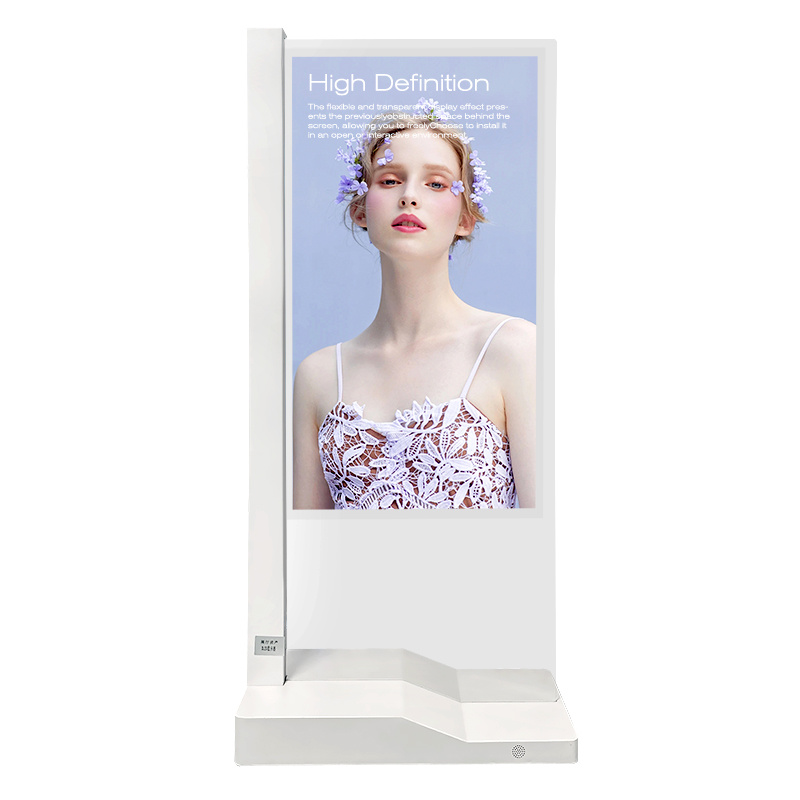
A floor standing transparent OLED display can vary significantly in price even when two units appear similar in photographs. The difference may come from the panel, screen size, resolution, touch layer, operating system, structural design, customization, or services included in the quotation. Buyers therefore need to compare complete configurations rather than focus on the initial unit price. Understanding these cost drivers makes it easier to select a floor standing transparent OLED that fits the viewing environment, content requirements, installation conditions, and expected operating life without paying for unnecessary features.

The Transparent OLED Panel Creates the Starting Cost
The panel normally represents a major part of the hardware value because transparent OLED technology is fundamentally different from conventional backlit signage. Each OLED pixel produces its own light, so a transparent panel does not require the separate backlight assembly used by an LCD. This structure makes a slim, see-through presentation possible, but it also requires specialized organic materials, transparent electrodes, precise deposition, encapsulation, testing, and drive electronics. Manufacturing roadmaps identify materials, substrates, production equipment, encapsulation, and yield improvement as important contributors to OLED production costs.
Screen size is one of the clearest variables. As the usable panel area increases, more substrate material is required, processing becomes more demanding, and the financial impact of a defective panel becomes greater. A larger floor standing transparent OLED also needs a stronger frame, wider protective glass, a more stable base, and packaging capable of protecting the expanded surface. Buyers should therefore avoid assuming that the price rises in a perfectly linear amount per inch. Moving from a compact unit to a larger commercial display can affect the panel, enclosure, transportation, handling, and installation costs simultaneously.
Resolution and transparency must also be evaluated together. Higher resolution supports finer text and more detailed visual content, while sufficient transmittance allows visitors to see objects or architecture behind the display. These objectives can create engineering trade-offs because the pixel structure and supporting circuitry must remain visually unobtrusive while maintaining image quality. The available floor-standing transparent OLED model is offered with 4K and Full HD resolution options, while its published transparency range is 38% to 45%. Selecting the required specification rather than automatically ordering the highest option can prevent unnecessary spending.
Panel protection and quality control further influence a quotation. Organic light-emitting devices require effective protection from oxygen and moisture, while commercial products must also be inspected for pixel defects, image uniformity, color behavior, and stable operation. Research on OLED degradation highlights the importance of fabrication consistency and barrier performance, particularly for protecting sensitive organic layers. A very low floor standing transparent OLED price may therefore reflect differences in panel sourcing, inspection standards, protective design, or replacement support rather than an equivalent product offered at a simple discount.

Configuration Choices Can Change the Final Price Quickly
The display panel is only one part of a complete floor-standing unit. A commercial system also needs a controller, memory, storage, connectivity, power components, thermal management, speakers or other optional hardware, and an operating environment capable of playing the intended content. A basic looping-video installation generally needs fewer computing resources than an interactive product catalog, real-time data dashboard, or application connected to a business database. Choosing processing hardware according to the actual software workload is therefore more economical than using the same high-end configuration for every installation.
The available Transparent OLED Digital Signage supports Windows and Android configurations. Published options include multiple memory and storage levels, ranging up to 16 GB RAM and 512 GB SSD for Windows configurations and up to 4 GB memory with 64 GB storage for Android. These choices affect both hardware cost and deployment complexity. A floor standing transparent OLED used for scheduled promotional videos may only require a straightforward Android setup, whereas custom Windows software or data-heavy applications can justify more memory, storage, and processing capacity.
Touch capability is another major decision. A non-touch unit can display transparent video overlays, advertisements, directions, or exhibit information at a lower system complexity. Adding a touch layer requires sensors, a controller, calibration, interface development, additional cabling, and testing to ensure that touch accuracy remains reliable across the screen. The product supports optional 10-point capacitive touch or infrared touch, and the correct technology depends on how visitors will interact with it. Capacitive touch suits familiar finger-based gestures, while infrared touch may be more appropriate where users operate the screen with gloves or alternative input objects.
The physical structure should not be overlooked. A floor standing transparent OLED needs a stable base, concealed electronics, protected wiring, and sufficient heat dissipation while preserving a slim appearance. The published design uses an aluminum chassis, tempered glass, concealed cabling, and internal thermal management. Each structural requirement affects materials, machining, assembly time, packaging weight, and service accessibility. A visually similar enclosure may cost less if it uses simpler finishing, reduced protection, or a base that was not engineered for the intended public environment.
Customization Adds Engineering and Production Work
Standard configurations are usually easier to price because their drawings, materials, production steps, and testing procedures have already been established. A customized floor standing transparent OLED may require a different enclosure color, branded exterior, revised dimensions, special ports, an integrated camera, sensors, or changes to the internal component layout. Even a modification that looks small can require mechanical drawings, engineering review, prototype confirmation, material sourcing, software adjustment, and additional testing. Buyers should distinguish between cosmetic customization and functional customization because the second category normally has a greater effect on cost and project risk.
The product is available in sizes from 32 to 65 inches, with black, white, and customized color options. Camera integration and other bespoke features are also offered. These choices allow the floor-standing transparent OLED display to match a retail environment, museum installation, showroom, corporate reception area, or hospitality space, but each optional element should solve a defined requirement. Ordering a custom camera housing, for example, is reasonable when the application uses video communication or computer vision, but it adds little value to a simple promotional display.
Order quantity also changes how engineering costs are distributed. A single customized sample must absorb much of the drawing, programming, setup, and verification work within one unit. In a larger order, some of these one-time costs can be shared across multiple displays, although panel availability, production scheduling, and quality inspection still affect the final quotation. Buyers requesting several floor standing transparent OLED units should ask whether the quoted unit price includes a prototype, production sample, custom tooling, spare parts, and configuration replication. Without that clarification, two suppliers may calculate “quantity pricing” on very different scopes.
Customization can also affect lead time. Standard colors, existing enclosures, established controller combinations, and familiar touch systems generally reduce preparation work. New structures or peripherals can require revised prototypes and approval before batch production begins. A realistic quotation should therefore connect price with a documented specification and approval process rather than promise both extensive customization and immediate delivery. Shenzhen Dinosaur Display’s support process includes requirement confirmation, product drawings, production, and customization of design, packaging, logos, and functional hardware.
Deployment and Service Affect Total Ownership Cost
The purchase price does not represent the complete cost of operating a floor standing transparent OLED. Freight can be substantial because the equipment includes a delicate glass panel, a rigid enclosure, and a weighted base. Export packaging must protect the panel from impact, vibration, pressure, and moisture during handling. Larger configurations may require reinforced crates, specialized loading, or higher freight charges based on dimensional weight. Urgent air transport can also cost considerably more than planned sea or ground transportation, particularly when multiple units are shipped together.
Installation expenses depend on the site. A freestanding unit avoids some wall-mounting work, but the buyer still needs a level placement area, accessible power, network connectivity, suitable ambient lighting, and safe pedestrian clearance. The transparent effect is strongly influenced by the relationship between displayed content, background objects, and lighting behind the screen. A buyer may obtain greater visual improvement from better content design and controlled background lighting than from selecting an unnecessarily expensive hardware upgrade. The product guidance recommends balanced lighting behind displayed objects to strengthen contrast and depth.
Software preparation is another frequently omitted expense. A floor-standing transparent OLED requires content designed for a see-through canvas; ordinary full-screen videos with bright backgrounds can hide the physical scene and weaken the intended effect. Designers may need to use dark or transparent areas, carefully positioned graphics, large readable text, and motion that complements the object behind the panel. Interactive installations also require interface development, touch testing, content updates, and sometimes integration with an existing content management system. These costs may sit outside the hardware quotation, so procurement teams should establish who is responsible for each task.
Long-term support changes the financial risk after installation. Ask what the warranty covers, how a defective panel or controller is diagnosed, whether remote assistance is available, and how replacement components are shipped. The published floor standing transparent OLED configuration carries a one-year warranty, while the company states that its engineering and production teams perform testing and provide technical support. A slightly higher initial quotation can be economically preferable when it includes clear documentation, remote troubleshooting, replaceable components, and realistic response procedures.

How to Compare Floor Standing Transparent OLED Quotes
A useful comparison begins with a common specification sheet. Sending only a screen size and asking for the lowest price encourages suppliers to make different assumptions about resolution, touch, computing hardware, enclosure materials, accessories, packaging, and support. Instead, define the application, expected content, viewing distance, lighting environment, operating schedule, software platform, interaction method, and delivery destination. Each floor standing transparent OLED quotation can then be evaluated against the same operational target rather than against an incomplete headline price.
Cost Area | Details to Confirm |
Display panel | Size, resolution, transparency, panel condition, inspection |
Touch system | Non-touch, capacitive touch, or infrared touch |
Computer | Operating system, processor, RAM, storage, connectivity |
Structure | Frame material, glass protection, base, finish, cable routing |
Customization | Color, branding, ports, camera, sensors, revised dimensions |
Delivery | Packaging type, freight terms, insurance, destination charges |
Service | Warranty scope, remote support, spare parts, replacement process |
Buyers should also request a clear list of exclusions. Installation, customs charges, local taxes, content production, application development, network work, and on-site commissioning may not be included in the equipment price. Asking for a delivered project cost prevents an apparently cheaper floor-standing transparent OLED display from becoming more expensive after unplanned services are added. It also helps finance teams separate one-time capital expenditure from recurring costs such as content updates, software licenses, maintenance, and replacement inventory.
Finally, compare value against the intended outcome. For a passive museum label or short promotional loop, touch technology and advanced computing may be unnecessary. For an interactive showroom configurator, reducing memory or selecting the cheapest touch system may damage responsiveness and visitor experience. The appropriate floor standing transparent OLED is not automatically the configuration with the most features or the lowest quotation. It is the unit whose panel, computing system, construction, customization, and support are proportionate to the application.
Conclusion
The price of a floor standing transparent OLED depends on the complete system rather than one visible specification. Panel size, resolution, transparency, touch technology, computing hardware, enclosure design, customization, packaging, installation, and support should all be compared against the intended application. Shenzhen Dinosaur Display Co., Ltd. is a digital signage manufacturer with assembly, testing, engineering, and customization capabilities documented on its website. A clearly defined project specification helps its floor-standing transparent OLED configurations balance visual performance, software compatibility, maintenance requirements, and total ownership cost without adding features that provide little practical value.
FAQ
Q: Why is a floor standing transparent OLED more expensive than standard LCD signage?
A: It uses a specialized self-emissive transparent panel, sensitive organic materials, precise manufacturing, protective encapsulation, dedicated electronics, and a floor-standing structure instead of a conventional backlit LCD assembly.
Q: Does a larger transparent OLED always provide better value?
A: Not necessarily. A larger panel increases visibility but can also raise enclosure, packaging, freight, handling, and installation costs without improving results in a limited viewing area.
Q: How much does touch functionality affect the price?
A: Touch adds sensors, controllers, calibration, assembly, and testing. The price difference also depends on whether the project needs capacitive or infrared touch technology.
Q: Should I choose Windows or Android?
A: Android often suits scheduled media and straightforward applications, while Windows may be preferable for specialized software, heavier processing, peripheral integration, or existing business systems.
Q: Why do two floor-standing transparent OLED quotations differ so much?
A: They may include different panels, resolutions, computers, touch systems, enclosure materials, customization, packaging, warranty terms, accessories, freight arrangements, and technical support.
Q: Can customization reduce the long-term value of the display?
A: Poorly planned customization can increase cost and complicate maintenance. Custom features should support a defined visual, operational, integration, or accessibility requirement.