Introduction
Choosing a mounting format is not simply a question of available floor or wall space. A transparent OLED must preserve useful sightlines, present content at a readable height, and reveal a background that contributes to the visual experience. A floor standing transparent OLED can become a movable focal point, while a wall-mounted installation can integrate more permanently with the surrounding architecture. The right decision depends on audience movement, interaction requirements, installation restrictions, content strategy, and long-term service access.

Start With the Viewer Path and the Background
Begin by identifying where viewers enter, where they slow down, and which direction they naturally face. A floor standing transparent OLED can be positioned directly within this route, angled toward approaching visitors, or moved as traffic patterns change. A wall-mounted screen depends more heavily on an existing surface being located within the audience’s normal field of view. Mounting a display on an available wall does not guarantee that people will notice it, especially when the wall sits behind them, above comfortable viewing height, or outside the main circulation path.
The background is equally important because transparency should reveal something worth seeing. Merchandise, an exhibition object, an architectural feature, or activity in an adjacent space can become part of the digital composition. If the screen only reveals a blank wall, utility area, or visually distracting environment, the transparent effect contributes little to the project. Before selecting either format, mark the intended display dimensions, photograph the viewing angle, and test sample graphics over the real background. This simple mock-up often reveals whether a floor standing transparent OLED or a fixed wall installation will produce the stronger composition.
Project Priority | Floor-Standing Format | Wall-Mounted Format |
Flexible positioning | Easier to reposition within an open area | Intended for a stable, predetermined location |
Floor-space conservation | Requires a planned footprint | Keeps circulation space below the display clear |
Direct interaction | Can be positioned at accessible touch height | Touch height must be established during installation |
Architectural integration | Functions as a distinct display object | Can align with partitions, walls, or built-in features |
Background control | Angle and location can be adjusted | Background remains tied to the mounting position |
Future relocation | Usually involves fewer building changes | May require removal and surface restoration |
When Floor Standing Transparent OLED Works Better
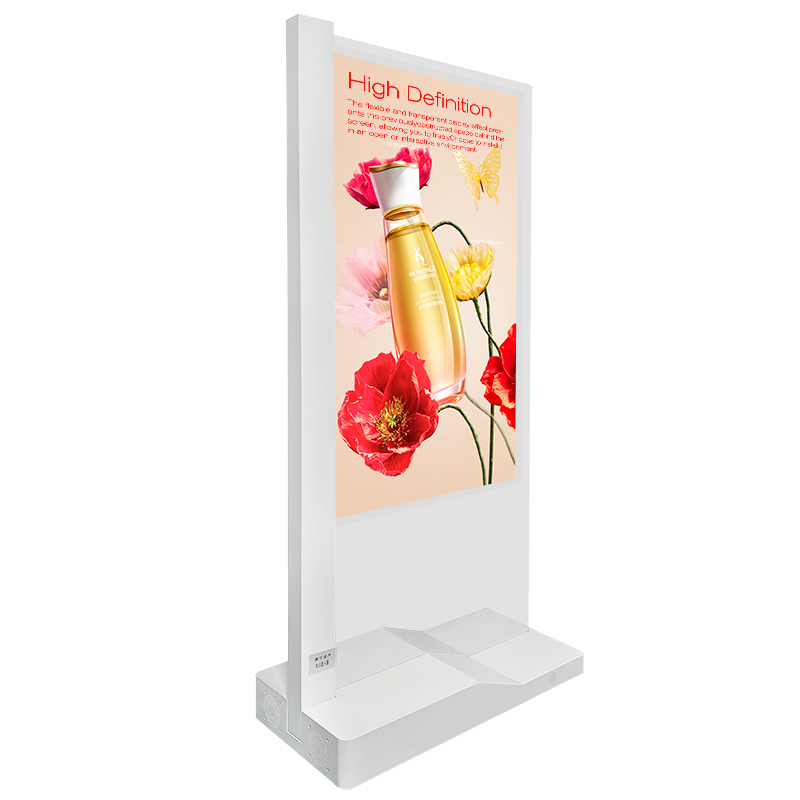
A floor standing transparent OLED is particularly effective in open retail areas, showrooms, exhibition booths, reception zones, and product-launch spaces where placement flexibility has operational value. The display can be positioned near an entrance during one campaign and moved closer to a featured product during another. It can also establish its own viewing angle instead of relying on the orientation of an existing wall. This makes the format useful when the audience route changes, seasonal displays are regularly rearranged, or the installation cannot permanently alter a rented venue.
The Floor-Standing Transparent OLED configuration is available in multiple sizes from 32 to 65 inches, with Windows or Android system options and optional capacitive or infrared touch. The same product platform lists both floor-standing and wall-mounted installation choices, allowing the enclosure and installation method to be considered alongside the required resolution, software environment, touch technology, color, and optional camera integration.
That flexibility does not remove the need for careful space planning. The base must remain outside escape routes, door swings, queue lanes, cleaning paths, and areas where carts or luggage may strike it. Power and data cables should be concealed or protected so the display does not introduce a trip hazard. A floor standing transparent OLED also needs enough clearance for people to view both the digital layer and the physical background without gathering in active circulation space.
When Wall-Mounted Transparent OLED Is the Better Fit
Wall mounting is often more suitable in narrow corridors, compact boutiques, reception areas, and permanent exhibits where every section of floor must remain available. It can create a cleaner architectural line because the screen, cables, and supporting components are coordinated with a fixed surface. The viewing position also remains consistent, which helps teams design content for a known distance and angle. For repeated informational content, permanent product displays, or installations that will not move between campaigns, this predictability can be more valuable than the flexibility of a floor standing transparent OLED.
However, wall mounting only saves useful space when the wall itself supports the transparent concept. A conventional opaque wall directly behind the panel can reduce the visual distinction between transparent OLED and ordinary digital signage. Stronger applications place the screen against a glass partition, open-backed structure, display recess, or designed merchandise area so viewers can see meaningful depth behind the graphics. A floor standing transparent OLED can be repositioned until this relationship works, but a wall-mounted screen requires the background, lighting, viewing angle, and content composition to be resolved before installation.
Interaction also requires closer attention with a fixed mount. The center of the screen must suit the intended users, while controls and touch targets should remain reachable without forcing uncomfortable arm positions. Service access cannot be treated as an afterthought, because technicians may need clearance around the enclosure and a safe method of reaching the display. Wall structure, mounting hardware, cable pathways, ventilation needs, and applicable building requirements should therefore be reviewed before the final display size is approved.
Compare Installation, Content, and Maintenance
Installation and Site Conditions
A floor standing transparent OLED normally concentrates its structural support in the enclosure and base, but the project team must still evaluate stability, impact exposure, and cable routing. A wall-mounted version transfers more responsibility to the supporting surface and mounting system. The wall must be suitable for the complete assembly rather than only the visible panel, and the installation should account for service clearance and cable bends. For either format, confirm the power location, network method, operating environment, delivery route, and final assembly procedure before production.
Content and Transparency Performance
Transparent OLED content should be designed together with the physical background rather than produced as a conventional full-screen video. Dark or empty content areas can reveal more of the scene behind the display, while brighter graphic elements become the digital foreground. Large opaque rectangles may hide the object or architecture that justified the transparent screen in the first place. Testing content on site is essential because reflections, background brightness, nearby lighting, merchandise color, and viewing distance can change the perceived balance between digital information and physical depth.
A floor standing transparent OLED offers an advantage during testing because its angle can be adjusted to reduce distracting reflections or improve alignment with a product. A fixed installation provides less freedom after mounting, so the content team should receive photographs and measurements from the actual viewing positions. Text must remain concise and large enough to read without overwhelming the transparent effect. Motion should guide attention toward the real object behind the screen rather than compete with it.

Maintenance and Operational Access
Maintenance costs are influenced by access, not only by display technology. A floor standing transparent OLED is generally reachable from ground level, which can simplify routine cleaning, cable inspection, and replacement planning. Its exposed location may also require more frequent checks for fingerprints, accidental contact, base damage, and changes in surrounding fixtures. Wall-mounted displays avoid some ground-level hazards, but cleaning or repair may require access equipment when the installation is high or located above permanent furniture.
Operational teams should also consider how often layouts will change. Moving a freestanding unit can be practical, but only when the delivery path, floor finish, power availability, and handling procedures support relocation. A wall-mounted screen may remain visually consistent for longer, although future removal can involve bracket work, cable changes, or surface repair. The appropriate format is the one that the facility team can safely inspect and maintain throughout the intended project life.
Use a Project Scorecard Before You Specify
A useful selection process assigns more weight to operational requirements than to the initial visual impression. Rate each format against the real site instead of comparing product photographs in isolation. Include representatives from design, facilities, content, information technology, and daily operations because each team will identify different constraints. The scorecard should be completed after a site survey and viewing-path test, not during the earliest concept discussion.
Decision Question | Favor Floor Standing | Favor Wall Mounting |
Will the display move between campaigns? | Movement is expected | Location will remain permanent |
Is open floor area available? | A protected footprint is available | Floor circulation is restricted |
Does the audience approach from changing directions? | Position and angle must remain adaptable | Viewers consistently face one surface |
Is touch interaction central to the experience? | Direct approach and accessible height are priorities | A suitable fixed touch height is possible |
Is the background already defined? | Location testing is still necessary | The background composition is permanent |
How will technicians reach the unit? | Ground-level access is preferred | Safe fixed-location access is available |
Choose a floor standing transparent OLED when placement flexibility, direct interaction, temporary campaigns, or adjustable alignment with physical products carries the most weight. Choose wall mounting when floor conservation, architectural integration, stable sightlines, and a permanent background are more important. Some projects can use both: a freestanding display may attract visitors at the entrance while a wall-mounted unit provides deeper information at a fixed exhibit. The formats should then share content rules, visual language, and management procedures so the installation feels like one coordinated experience rather than unrelated screens.
Do not base the decision on mobility alone. A unit that can technically be moved may still remain stationary because of its size, cable arrangement, surrounding fixtures, or handling requirements. Likewise, wall mounting is not automatically less flexible if the project includes an accessible service structure and replaceable mounting components. The final specification should document placement, mounting responsibility, viewing height, touch requirements, background treatment, cable routing, maintenance access, and the process for future changes.

Conclusion
The choice depends on how the display must interact with people, architecture, and physical objects. A floor standing transparent OLED is a strong fit for adaptable placement, direct engagement, and frequently changing layouts, while wall mounting suits permanent sightlines and space-conscious installations. Shenzhen Dinosaur Display Co., Ltd. is a digital signage manufacturer offering transparent OLED configurations with multiple sizes, system options, touch choices, and both installation formats. A site-based comparison of visibility, background value, safety, content, and maintenance will produce a more reliable specification than selecting by appearance alone.
FAQ
Q: Is floor standing transparent OLED suitable for retail stores?
A: Yes. It suits retail areas with open floor space, changing promotions, visible merchandise, and audience routes that benefit from adjustable screen placement and viewing angles.
Q: Can floor standing transparent OLED signage also be wall-mounted?
A: Some product platforms support both installation methods. The enclosure, mounting hardware, structural support, cable arrangement, and service access must be specified for the selected configuration.
Q: Does a wall-mounted transparent OLED always save space?
A: It preserves floor area, but the project still needs wall clearance, cable routes, service access, and a useful background behind the transparent display surface.
Q: Which configuration is easier to maintain?
A: Freestanding units are often easier to reach, while wall-mounted screens avoid some ground-level contact. Actual maintenance depends on height, enclosure design, surroundings, and access planning.
Q: How should content differ from ordinary digital signage?
A: Use concise text, selective bright graphics, controlled motion, and transparent areas that reveal the physical background instead of covering it with full-screen opaque layouts.