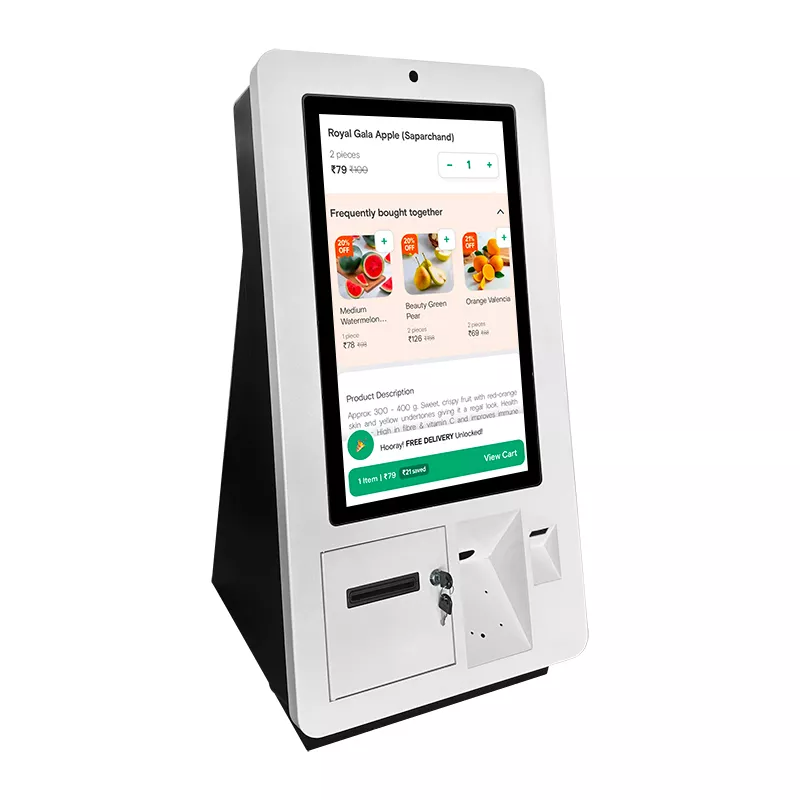
Self-ordering kiosks have become a standard feature in quick service restaurants (QSRs), where speed, accuracy, and order volume are critical. However, limiting self-ordering kiosks to QSRs no longer reflects how food-service businesses operate today. As menus become more customizable and customer expectations continue to rise, ordering kiosks are proving effective in many food-ordering environments beyond traditional fast food.
It is important to clarify that a self-ordering kiosk is not a general-purpose self-service terminal. Its core function is focused entirely on food and beverage ordering—menu browsing, item customization, order confirmation, and payment. When used correctly, ordering kiosks improve operational efficiency, reduce ordering errors, and increase average order value.
What Defines a Self-Ordering Kiosk
Core Ordering Functions
A self-ordering kiosk is designed specifically for food-service transactions. Its essential functions include:
Displaying digital menus with images and prices
Supporting item customization such as size, flavor, or add-ons
Processing orders directly into POS or kitchen systems
Accepting digital payments
Unlike general self-service kiosks, ordering kiosks are optimized for fast decision-making and order accuracy. Every interface element serves the goal of completing an order efficiently.
Why Ordering Focus Matters
When kiosks are used strictly for ordering, businesses benefit from:
This clarity of purpose is the reason self-ordering kiosks can be successfully applied in various food-related settings beyond QSRs.
![imageye___-_ Kiosk (2)]()
Why Self-Ordering Kiosks Work Beyond Traditional QSRs
Fast Casual Restaurants
Fast casual restaurants often feature more complex menus with multiple ingredient choices, cooking preferences, and dietary options. Self-ordering kiosks allow customers to review these options carefully without pressure from waiting lines. This improves order confidence and reduces errors while maintaining service speed.
Cafés and Beverage-Focused Businesses
Cafés, coffee chains, and beverage shops rely on repeat orders with minor variations, such as sweetness level, milk type, or toppings. Ordering kiosks manage these selections clearly and consistently, reducing the burden on staff during peak hours. Visual prompts also encourage customers to upgrade sizes or add extras, increasing average order value.
Bakeries and Grab-and-Go Food Concepts
In bakeries and grab-and-go food stores, ordering kiosks help manage high customer flow, especially during morning and lunch rushes. Customers can browse products visually, select multiple items in one order, and complete payment quickly. Digital ordering reduces congestion at the counter and allows staff to focus on preparation and packaging.
Food Ordering in Entertainment Venues
In cinemas, stadiums, and entertainment venues, self-ordering kiosks are commonly used for food and beverage ordering such as popcorn, snacks, and drinks. These environments experience short but intense demand peaks. Ordering kiosks allow multiple customers to place orders simultaneously, reducing wait times and improving overall concession efficiency.
Operational Benefits of Self-Ordering Kiosks
Faster Order Throughput
Self-ordering kiosks increase throughput by enabling parallel ordering. Multiple customers can place orders at the same time, which is especially valuable during peak hours. This approach helps businesses serve more customers without expanding front-counter staffing.
Improved Order Accuracy
Because customers input their own selections, misunderstandings are minimized. Customizations and add-ons are clearly displayed and confirmed before payment. Higher order accuracy reduces remakes, food waste, and customer complaints.
Labor Optimization
Ordering kiosks allow businesses to allocate staff more effectively. Employees can focus on food preparation, quality control, and customer assistance rather than repetitive order-taking tasks. This improves productivity and supports consistent service quality.
Revenue Growth Through Self-Ordering Kiosks
Upselling and Cross-Selling Opportunities
Self-ordering kiosks naturally support upselling through on-screen suggestions such as combo meals, add-on items, and limited-time offers. These prompts are standardized and data-driven, often resulting in higher average order values compared to traditional counter ordering.
Visual Menu Presentation
Digital menus with high-quality images and structured layouts influence purchasing behavior. Customers are more likely to explore additional items when menus are visually engaging and easy to navigate. Ordering kiosks turn menu presentation into an active sales channel.
Technology Supporting Modern Self-Ordering Kiosks
POS and Kitchen System Integration
Modern self-ordering kiosks integrate directly with POS systems and kitchen display systems. Orders are transmitted instantly, reducing delays and eliminating manual entry errors. This integration ensures a smooth and reliable ordering workflow from customer to kitchen.
Flexible Menu Management
Menus can be updated centrally to reflect pricing changes, item availability, or promotional campaigns. This flexibility allows food-service businesses to respond quickly to market conditions without operational disruption.
Data-Driven Ordering Optimization
Ordering kiosks collect valuable data on customer preferences, popular items, and ordering patterns. Businesses can analyze this information to refine menu structure, optimize pricing strategies, and improve overall ordering efficiency.
The Long-Term Role of Self-Ordering Kiosks in Food Service
As food-service operations continue to prioritize speed, accuracy, and cost control, self-ordering kiosks will remain a core component of modern restaurant systems. Their scalability and adaptability make them suitable for a wide range of food-ordering environments while maintaining a clear focus on ordering functionality.
Conclusion
Self-ordering kiosks work beyond QSRs because food ordering needs are consistent across different service formats. Wherever customers need to browse menus, customize items, and place orders efficiently, ordering kiosks deliver measurable value. By improving order accuracy, increasing throughput, and boosting average order value, self-ordering kiosks support sustainable growth for food-service businesses. Shenzhen Dinosaur Display Co., Ltd. provides customizable self-ordering kiosk solutions designed specifically for food and beverage ordering, helping businesses enhance operational efficiency and customer experience.